1060 WIEN . GUMPENDORFERSTRASSE 16/8 | office@sylvia-petz.at | +43 699 1100 8040






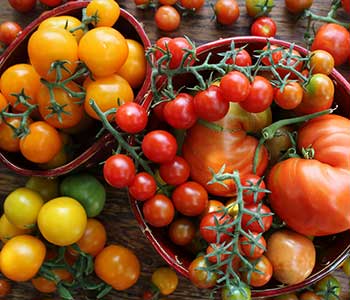
It’s the star of the salad, the soul of every sugo, the heart of ketchup – and yet very few people realise just how fascinating the history of the ‘Paradeiser’ is. That’s right: ‘Paradeiser’. Not ‘tomato’. But let’s take it one step at a time.
July 2026
Summer is synonymous with sun-ripened fruit and vegetables. For me personally, the ‘Paradeiser’ – as we in Eastern Austria call tomatoes – holds a special place. In the garden, there’s a colourful mix of varieties, ranging from small and oval to yellow and round, egg-shaped and cherry-red, right through to huge and dark pink. Each fruit is lovingly harvested, eaten straight away, reduced to a rich tomato sauce, or preserved for the winter. A hymn to the tomato – or, the ‘paradeiser’.
Tomato, ‘Paradeiser’ or ‘Pomodoro’? The Aztecs called it ‘xitomatl’; the Spanish turned it into ‘tomate’. This term was adopted in German-speaking countries. However, in eastern Austria and South Tyrol, the fruit is affectionately known as ‘Paradeiser’ – presumably in reference to the ‘Paradeisapfel’, or ‘apple from the exotic paradise’. In Italy, it was given the poetic name ‘pomodoro’, meaning ‘golden apple’, probably because the first known varieties were yellow. Interestingly, in Hungarian too, the tomato is called ‘paradicsom’ – which may have further reinforced the use of the term ‘Paradeiser’ in eastern Austria. Today, the term ‘Paradeiser’ survives almost exclusively in Vienna, Lower Austria and Burgenland. For the vast majority of the country, it is simply the ‘tomate’.
A long journey. The ancestors of today’s tomatoes grew in the Andes in Ecuador and Peru, where the fruits were no bigger than cherries. From there, they made their way north, where indigenous peoples in Mexico began to cultivate them deliberately and to select larger, fleshier fruits. In the 16th century, they were brought to Europe by the Spanish conquistadors, probably more as an ornamental plant than as a foodstuff. For a long time, they remained something of a niche crop; it was not until the 19th century that they gained a foothold in southern Europe and gradually found their way into salads, on pizzas and in pasta dishes, thus becoming an indispensable foodstuff in northern countries too.
Healthy! The tomato – which, botanically speaking, is a berry – is rich in minerals, antioxidants and vitamins, and is particularly low in calories at 17 kcal per 100 g. With a high water content of 94 per cent, it is the ideal refreshing food for summer. However, anyone with histamine intolerance should avoid tomatoes. This also applies to people who are prone to heartburn. The sugar in tinned and processed tomatoes could exacerbate this condition.
My favourite summer meal. The many different tomato plants in my garden produce plenty of colourful fruit right into late autumn. Thanks to meticulous pruning, powdery mildew doesn’t stand a chance, and the plants remain vigorous right up until the first frost. Any surplus tomatoes are cooked down without seasoning and stored in screw-top jars in the freezer. That way, summer regularly finds its way onto the table in winter too. And usually like this:
SIMPLE PASTA RECIPE: Wash the tomatoes and cut them, unpeeled, into cubes of about 1.5 cm. Finely chop the fresh garlic, sauté briefly in olive oil, then add the tomatoes and season with salt. Now simmer over a medium heat until the sauce thickens slightly.
I like to add a generous sprinkling of chilli now and leave out the Parmesan later, along with another dash of top-quality olive oil.
Add the spaghettini, cooked al dente, to the sauce, mix well and leave to stand for two minutes.
Serve and top with roughly chopped basil. If you like, grate some Parmesan over the top. May this pasta bring you happiness too!
By the way, it also goes wonderfully with boiled potatoes, crisply fried courgette slices, or simply eaten straight from the pot. And one more thing: tomatoes that don’t ripen on the vine in the cool autumn weather will do so at the kitchen table in the warmth. It works a treat! A little tomato purée gives them the sweetness and intensity they’re lacking. True to the motto: capturing the summer!
