



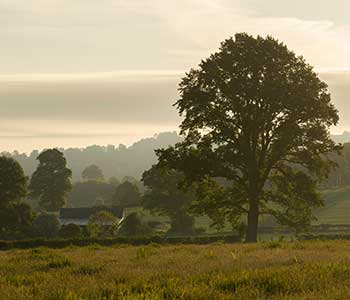
As is the case almost everywhere, it’s all about togetherness with the Oaks too. As well in the vineyards.
An important finding for winegrowers as well: oaks, like other trees, need neighbouring trees of the same species to thrive and remain resilient. This is an aspect that should be considered in agroforestry and, more specifically, in vitiforestry systems.
May 2026
University of Natural Resources and Life Sciences, Vienna (BOKU) (2026). BOKU study shows: solitary oaks lose their natural reproductive rhythm. Press release, 11 May 2026. → Link to the press release in German language
When Oaks Become Isolated, They Produce Far Fewer Seeds: Their Shared Fruiting Rhythm Breaks Down. Researchers at BOKU University Vienna and international partners have demonstrated for the first time that isolated oak trees produce significantly fewer seeds and gradually lose their natural reproductive rhythm. The findings were published in the prestigious scientific journal PNAS (Proceedings oft the National Academy of Science).
The study focused on California oaks whose seed production was monitored over more than a decade in a highly fragmented agricultural landscape. Many of the trees stood far from other oaks, with striking consequences: isolated trees received insufficient pollen and consequently produced far fewer acorns.
“We were able to show for the first time that isolation disrupts the natural synchronisation of seed production,” explains Mario Pesendorfer of BOKU’s Institute of Forest Ecology. “Normally, oaks produce exceptionally large seed crops simultaneously in certain years, a phenomenon known as masting. Isolated trees lose this shared rhythm, even when they are only a few hundred metres apart.”
Implications for forests and biodiversity. Mast years play a crucial role in the natural regeneration of forests and provide an important food source for many seed-eating animal species. They are also essential for the production of forest reproductive material. When individual trees produce fewer seeds and no longer fruit in synchrony with others, long-term consequences for forest regeneration may follow.
The research is based on an exceptionally long-term dataset. Seed production of California oaks has been documented for hundreds of individual trees since 1980. Since 2014, Mario Pesendorfer has collaborated on this long-term project with lead author Ian Pearse (United States Geological Survey, USGS) and renowned oak researcher Walter Koenig (Hastings Natural History Reservation, University of California, Berkeley).
The findings are also relevant for Austria. “We often see solitary old oaks standing in fields or vineyards. It is quite possible that these trees face similar challenges and therefore produce seeds less successfully,” says Pesendorfer. Similar effects have already been observed in native silver fir populations, where fragmented stands suffer from pollen limitation and reduced germination rates. Given the growing demand for climate-adapted tree species, this may already contribute to shortages of planting material for reforestation.
Fragmentation as an underestimated consequence of landscape change. The study highlights that, alongside climate change, landscape fragmentation can have profound effects on forest ecosystems. When trees become too widely separated, their reproductive success declines, even in wind-pollinated species such as oaks.
The researchers see this as an important message for conservation, landscape planning and forestry. While solitary trees remain ecologically valuable, long-term reproductive stability requires neighbouring trees of the same species within effective pollination distance.
The study focused on California oaks whose seed production was monitored over more than a decade in a highly fragmented agricultural landscape. Many of the trees stood far from other oaks, with striking consequences: isolated trees received insufficient pollen and consequently produced far fewer acorns.
“We were able to show for the first time that isolation disrupts the natural synchronisation of seed production,” explains Mario Pesendorfer of BOKU’s Institute of Forest Ecology. “Normally, oaks produce exceptionally large seed crops simultaneously in certain years, a phenomenon known as masting. Isolated trees lose this shared rhythm, even when they are only a few hundred metres apart.”
Implications for forests and biodiversity. Mast years play a crucial role in the natural regeneration of forests and provide an important food source for many seed-eating animal species. They are also essential for the production of forest reproductive material. When individual trees produce fewer seeds and no longer fruit in synchrony with others, long-term consequences for forest regeneration may follow.
The research is based on an exceptionally long-term dataset. Seed production of California oaks has been documented for hundreds of individual trees since 1980. Since 2014, Mario Pesendorfer has collaborated on this long-term project with lead author Ian Pearse (United States Geological Survey, USGS) and renowned oak researcher Walter Koenig (Hastings Natural History Reservation, University of California, Berkeley).
The findings are also relevant for Austria. “We often see solitary old oaks standing in fields or vineyards. It is quite possible that these trees face similar challenges and therefore produce seeds less successfully,” says Pesendorfer. Similar effects have already been observed in native silver fir populations, where fragmented stands suffer from pollen limitation and reduced germination rates. Given the growing demand for climate-adapted tree species, this may already contribute to shortages of planting material for reforestation.
Fragmentation as an underestimated consequence of landscape change. The study highlights that, alongside climate change, landscape fragmentation can have profound effects on forest ecosystems. When trees become too widely separated, their reproductive success declines, even in wind-pollinated species such as oaks.
The researchers see this as an important message for conservation, landscape planning and forestry. While solitary trees remain ecologically valuable, long-term reproductive stability requires neighbouring trees of the same species within effective pollination distance.