



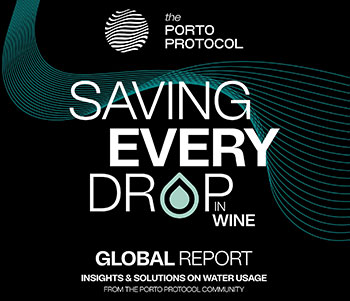
New global report on water awareness in the wine industry
Central Europe is facing water scarcity. In Austria, the current lack of rainfall is putting harvests at risk. For cereals, maize, and soybeans, total crop failure is a real possibility, as seeds are unable to germinate. Drought is also a major issue in viticulture. However, it can be mitigated to some extent through vine training, soil management, and canopy work. There are also opportunities to reduce water consumption in the cellar.
The Porto Protocol has now published a 200-page report on this topic.
May 2026→ Free download of the report: Saving Every Drop in Wine
Vines are particularly sensitive at this stage. While their deep root systems allow them to access water reserves in the soil, these reserves must be regularly replenished. If rainfall is lacking, it becomes increasingly difficult for vines that are meant to remain in the vineyard for many years.
For this reason, and because water availability has generally become less predictable, the Porto Protocol has published a new report. This global network aims to accelerate climate action within the wine sector.
At the end of April, it released “Saving Every Drop in Wine”: a more than 200-page document compiling global insights and practical approaches from its community of winegrowers and scientists. At its core, the report calls for a reassessment of how the wine industry manages water—both in the vineyard and the cellar, as well as across supply chains.
Rather than offering a one-size-fits-all solution, the report reflects a diversity of regional approaches, united by a shared principle: working with natural systems rather than against them. It examines water across interconnected levels, from global cycles and traditional practices to soil function and regenerative hydrology in both vineyard and cellar. The report is available free of charge: Saving Every Drop in Wine
Contributions from recognised experts under pin the publication. Developed with input from specialists such as Cornelis van Leeuwen, Hervé Quénol, Linda Johnson-Bell, Lucrezia Lamastra, Mimi Casteel and Nicolas Quillé, it brings together perspectives from different disciplines and regions. The project was led by Brazilian winemaker Jihany Brecci, who notes: “The wine industry stands at a crossroads when it comes to water. Scientific insight and practical experience must come together to support informed, long-term decisions.”
And us? We enjoy the sunshine, go hiking, sit in the garden. And I, for one, hope for rain.